← 2NE1.COM HOMEPAGE / DOSSIER: ARTIFICIAL LIFE & RESEARCH

Artificial Life & Minds.

Autonomous Agents, Morphology Evolution & Emergent Intelligence.

CyberLife Technology / Creature Labs · BBC CBBC · Google DeepMind · 1997–2026
a
l
i
f
e
>>

The Creatures Series (1997–2003)

CyberLife Technology / Creature Labs
Creatures Technical Architecture presentation by Dylan Banarse

Senior Researcher and Head of Artificial Life at CyberLife Technology and Creature Labs, involved from Creatures 1 (C1, 1997) through Creatures 2, Creatures 3, and Docking Station.

Co-architect of the biological computational substrate that powered autonomous virtual organisms ("Norns"). Designed heterogeneous multi-lobe neural networks with operant conditioning, a 256-chemical endocrine/receptor metabolic engine, and mutable haploid digital chromosomes enabling true digital genetics, heredity, hunger, pain, learning, and open-ended reproduction.

View Tech Architecture Presentation (Google Slides) ↗
>>

BBC BAMZOOKi (2003–2009)

BBC Children's Television

Technical & Creative Product Lead across four broadcast series of the BAFTA-nominated BBC children's TV show. Engineered the downloadable 3D Zook Kit, allowing hundreds of thousands of children to build physics-based virtual creatures using rigid bodies, joints, spring/damper kinematics, and neural locomotion controllers.

Contestants' winning creature designs were summoned onto a physical table in the BBC television studio using real-time broadcast mixed-reality camera tracking, competing in agility, sprint, hurdle, and push tests.

YouTube ↗ BBC Programme Archive ↗
>>

A-Life on Pi (2016–2024)

Low-Cost Edge Emergence
A-Life on Pi cellular automata

Lo-fi artificial-life simulations and cellular automata designed specifically to run in real time on low-end single-board computers (Raspberry Pi), exploring how complex emergent patterns and micro-biochemistries can thrive on extreme resource constraints.

Visit A-Life on Pi (alifeonpi.com) ↗
s
u
m
o
>>

Evolving 3D Sumo Ants: Joint Policy Learning & Morphology Evolution

ACM / GECCO 2019 · Google DeepMind

"The body is not a given: Joint Agent Policy Learning and Morphology Evolution" (ACM / GECCO 2019). Research conducted at Google DeepMind exploring continuous co-adaptation in embodied agents.

In standard reinforcement learning, agent morphologies are fixed and only neural network weights are updated. Here, both physical 3D body structures (limb lengths, joint limits, torque multipliers, and mass distributions) and deep reinforcement learning neural policies are simultaneously evolved in competitive MuJoCo physics sumo wrestling, where two agents fight to shove each other out of a circular ring.

(Note: this is virtual morphology evolution in MuJoCo physics, not the physical EvoBorg robot).

Read ACM Research Paper (DOI) ↗
m
i
n
d
s
>>

AI & Agency Research: Communication, Scaffolding & Self-Referential AI

Google DeepMind Reprints
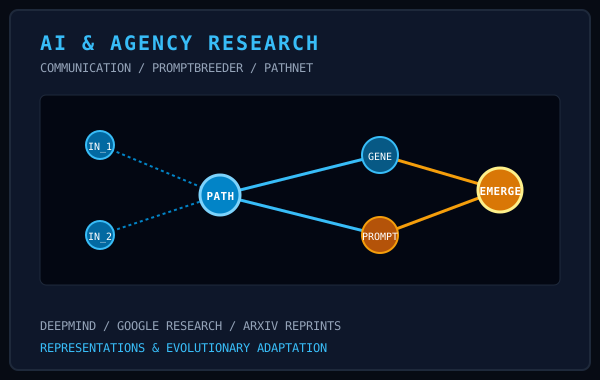
AI & Agency Research: Emergent Communication & Evolutionary Paths

Foundational research exploring how intelligent agents develop emergent communication, scaffold collective memory, and autonomously optimize cognitive strategies:

Wanting to be Understood: How External Representations Shape Communication (2024)

Investigates how the introduction of shared external representations (drawings, tokens, diagrams) transforms multi-agent coordination from private internal models into grounded, collaborative cultural protocols.

Promptbreeder: Self-Referential Self-Improvement via Prompt Evolution (2023)

An evolutionary algorithm that evolves not only task-prompts for large language models, but also the mutation-prompts that steer that evolution—creating an open-ended self-referential improvement loop.

PathNet: Evolution Channels Gradient Descent in Super Neural Networks (2017)

A neural network architecture where genetic algorithms discover active pathways through a giant neural matrix, allowing distinct skills to be learned sequentially without catastrophic forgetting.

← Back to Homepage View Lux Automata 3D Sculpture ↗
Media Specimen